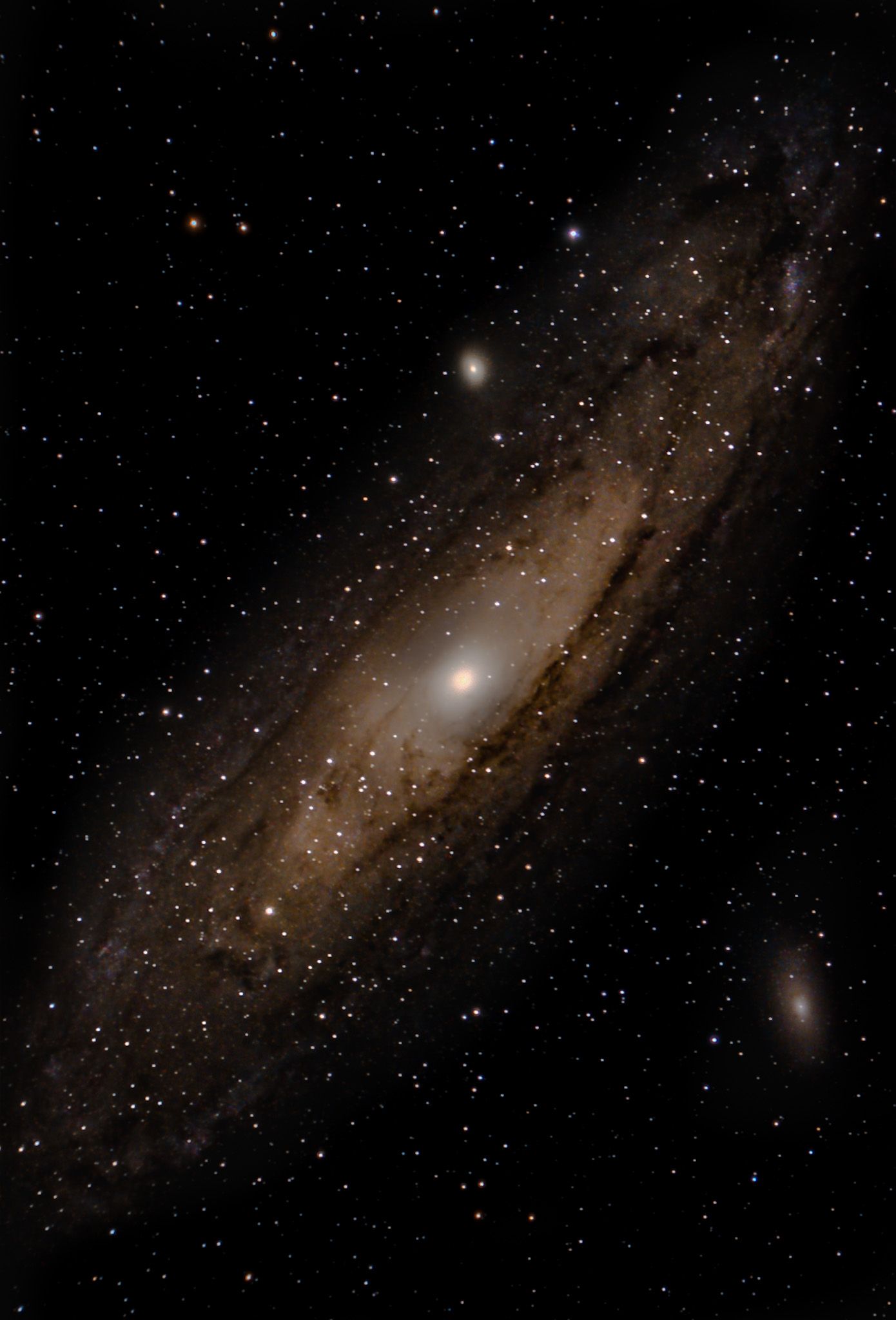
M31 – The Andromeda Galaxy
Introduction
M31, or the Andromeda Galaxy, is our neighbour and the closest galaxy to us (if you exclude the Canis Major Dwarf Galaxy, which our Milky Way is currently swallowing), at about 2.5 million light-years.
A bit of history
- ~960: First recorded visual observation, described as "a fuzzy patch in the sky" (they didn't have a light-pollution problem back then, lucky them).
- 1612: First observation through a telescope by Simon Marius. Still "a fuzzy patch", but he locates it in the constellation of Andromeda.
- 1764: Charles Messier adds M31 to his catalogue.
- 1887: Isaac Roberts takes the first photograph of it.
- 1920-1923: Edwin Hubble confirms that M31 really is outside the Milky Way.
A few facts
- M31 is a spiral galaxy about 220,000 light-years across (versus 150 to 200,000 for the Milky Way) and made up of around 1 trillion stars (4 times more than the Milky Way).
- In ~4 billion years, the Milky Way and M31 will merge to form a new galaxy.
- Like the Milky Way, M31 rotates at ~220 km/s (that's London–Edinburgh in 4 seconds, if you like absurd comparisons).
My photo
Now that you've got enough to show off at your next dinner party, let's move on to my photo. In astrophotography, we stack: we take lots of photos to accumulate signal, then combine them to get a raw image that we'll process afterwards.
M31, although pretty huge, is faint. Under a very dark sky, you can see it with the naked eye as a small fuzzy patch. In the city, forget naked-eye observing: you need a CLS (City Light Pollution) filter to cut the pollution and see it through a telescope.
Faint means the individual exposure time has to be long. For me, the S30 is limited to 60 s, but you could go up to 180–300 s. And given M31's size, a relatively short focal length is preferable.
Since I like to sleep at night, I spread the captures over several evenings, avoiding full-moon nights:
- 12 October 2025: 3h of captures
- 13 October 2025: 2h of captures
- 14 October 2025: 2h of captures
- 15 October 2025: 2h30 of captures
That's a total of 9h30 of captures, or 570 photos. I made the dumb mistake of not keeping the individual frames after processing, but on each of them you could barely see the galaxy, with very little detail.
Then, sorting: you drop the photos with star trails that are too pronounced, or those where a plane/satellite left a nice bright streak. That left me with 360 usable photos. After stacking, you get a raw image.
First impression: it's black, you can just make out the bulge. But that's normal: raw format, no processing, no histogram stretch.
Then you go through specialised software (SiriL for me) to process the photo: colour, star density, colour curves, and so on. I do a last pass in Lightroom for the final tweaks, and here's the result:
Gear and method
- Telescope: ZWO Seestar S30 in EQ mode
- Filter: CLS
- Individual exposure time: 60 seconds
- Software: SiriL for stacking and Lightroom for the final edit
- Total frames kept: 6h out of the initial 9h30
Conclusion
I'm pretty happy with the result, especially since I'm really just starting out in astrophotography. Even if the S30 did a lot of the heavy lifting, it makes me want to invest in more gear (but man, is it expensive!).
This isn't my first attempt: I've already photographed a few targets since February 2025, and I'll present them in detail soon (you can already find them on the dedicated page).
I help teams with this kind of split — short audits or longer engagements.
Let’s talk