1999
I already told you in my 2025 retrospective about the photo of the 1999 eclipse that hung at my uncle's house, and about my wish to see one with my own eyes.
There was the partial eclipse in March 2025, but this year I had the chance to see a total one — almost: it would reach 97.5%, which was already much better than last year's 30%.
And guess what? I finally got myself a Seestar S30 Pro, the perfect opportunity to test it out!
The eclipse from my terrace
Getting ready
97.5%. That's pretty good for an eclipse that was already going to be great to watch, as shown by the general excitement in France: there was at least one news segment about it every day for two weeks, and special eclipse glasses were in short supply just a few days before.
In France, we weren't going to be lucky enough to get a total eclipse; for that, we would have had to go to Spain.
But then I had a problem: THE PRICE OF HOTELS! Up to several hundred euros for one night within the path of totality. Oh well, I would have to settle for 97.5% from Bordeaux.
As for the rest, I was all set: I had my smart telescope, my Maksutov 127 with its solar filter for visual observation and, of course, a pair of eclipse glasses.
In Bordeaux, first contact was scheduled for 7:29 pm, “totality” at 8:24 pm and the end at 9:16 pm. That created another problem: the eclipse would happen around sunset, with the Sun low on the horizon — around 7° — and from my terrace, right along the eclipse’s path, there is the naval base.
I grimaced a little because I hadn't anticipated that; I thought it would be higher in the sky. I checked Stellarium and, phew... the near-totality would be visible without obstruction, but the Sun would disappear behind the big concrete building a few minutes later.
The eclipse
I was ready at exactly 7:12 pm, with only a few minutes left before it began. I kept checking the Seestar and the Mak127 over and over. I made sure they were still properly aligned, that the tracking was OK and... I paced around.
One minute before the start, I did one last check, started the timeline on the Seestar and pressed my eye to the eyepiece while waiting. Then, right on time, it was there.
That small black arc on the right is the Moon beginning to obscure the Sun: first contact, known as C1. I smiled; I was happy. You can't see it in the Seestar photo, but through the Mak127, slight features were visible along the edges. It was pretty impressive.
Until the maximum, I spent my time taking photos and pressing my eye to the eyepiece. I couldn't stop smiling like a kid.
A few moments before the maximum, there was a very pleasant slight drop in temperature — it was 32°C — along with a slight decrease in brightness. And once again, right on schedule...
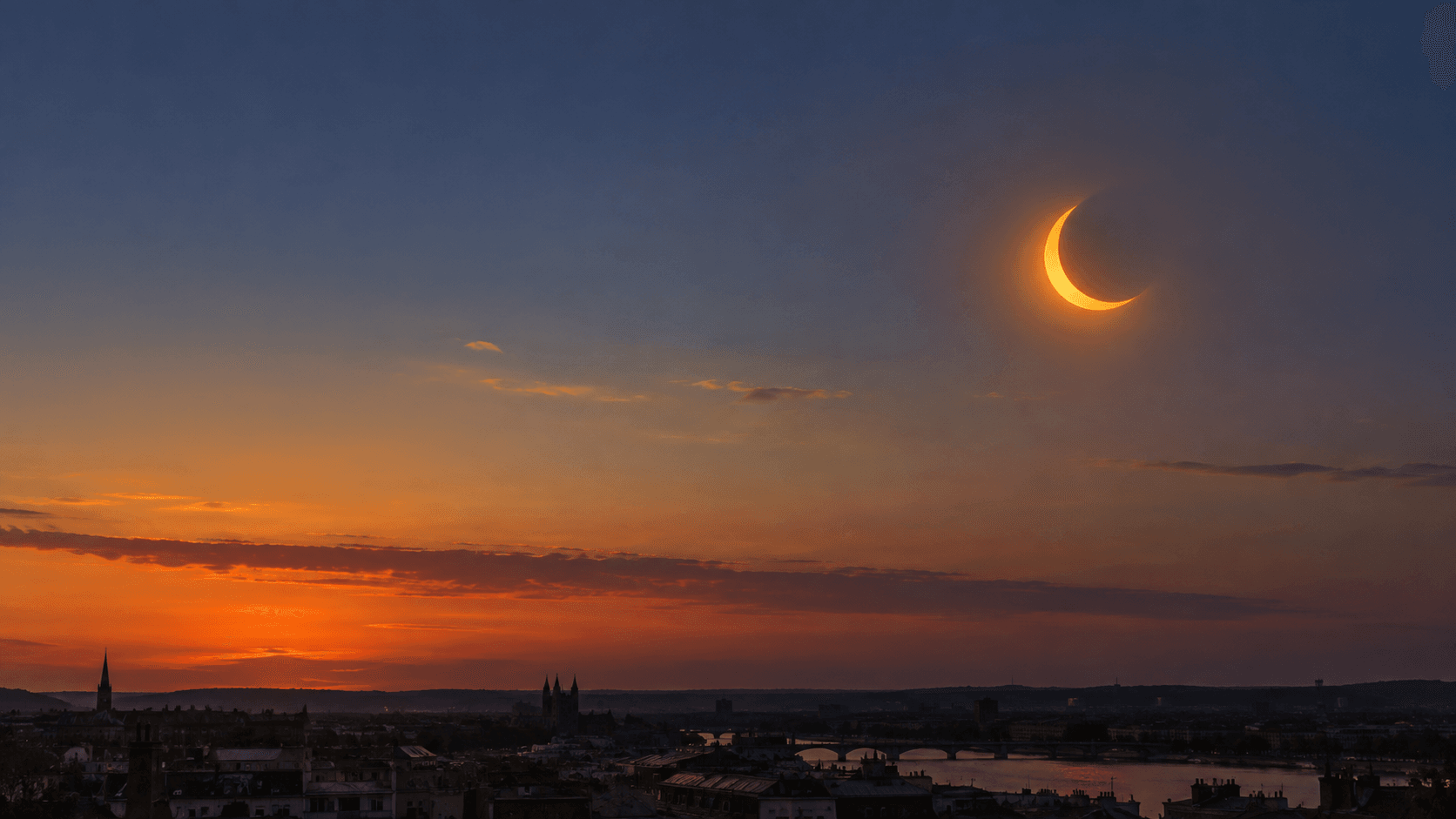
The famous 97.5%! I took advantage of the little more than 60 seconds to put on my eclipse glasses and watch it directly. It was less impressive than through the telescope — just a small orange arc — but still impressive.
Barely had time to enjoy it before the Moon continued on its path, the temperature rose again and the light returned.
I enjoyed it for a few more moments, then the Sun quickly disappeared behind the naval base. So I packed up my equipment. As soon as I got inside, I checked and reworked the timeline.
The stabilisation got a little messed up at the end — I must have passed too close to the telescope and caused vibrations.
But what exactly is an eclipse?
I couldn't talk about the eclipse without adding a short section on what an eclipse is and how it works.
What is an eclipse?
An eclipse occurs when the Sun, Earth and Moon line up almost perfectly. Depending on which celestial body is in the middle, we see either a solar eclipse or a lunar eclipse.
On 12 August 2026, there was a total solar eclipse in Spain and a partial one here in France.
How does a solar eclipse work?
During a solar eclipse, the Moon passes between Earth and the Sun at the new Moon. Its shadow is then cast onto our planet:
- In the umbra (the central shadow), the Sun is completely hidden: this is a total eclipse, as in Spain.
- In the penumbra, only part of the Sun is obscured: this is a partial eclipse, as in France.
- If the Moon appears slightly too small to cover the Sun completely, a bright ring remains visible: this is an annular eclipse, also called a “ring of fire”.
Eclipses do not occur at every new Moon: the Moon's orbit is tilted by about 5° relative to the plane of Earth's orbit, so most of the time its shadow passes above or below Earth.
Key point: the Sun is about 400 times wider than the Moon, but it is also about 400 times farther away. This coincidence in apparent size is what makes total eclipses possible.
The four contacts: C1, C2, C3 and C4
Astronomers describe the course of a solar eclipse using four precise moments called contacts. They correspond to the moments when the apparent edges of the Moon and Sun meet.
C1 — the beginning of the partial eclipse
At first contact, the Moon begins to “bite” into the edge of the Sun — see the first eclipse photo. The partial eclipse begins: with suitable eclipse glasses, the solar disc gradually appears to be eaten away, a little like Pac-Man.
C2 — the beginning of totality
At second contact, the Moon completely covers the Sun. For observers within the path of totality, night seems to fall in broad daylight and the solar corona becomes visible.
During totality, it is possible to remove eclipse glasses and look directly at the eclipse.
C3 — the end of totality
At third contact, the first glint of sunlight reappears from behind the Moon. Totality is over: this is when you need to put your eclipse glasses back on.
C4 — the end of the partial eclipse
At fourth contact, the Moon completely leaves the solar disc. The eclipse is over.
The times of C1 to C4 vary depending on the observation location. Outside the path of totality, C2 and C3 do not occur: in France, we therefore only had C1 and C4.
Safety: never look directly at the Sun, even during a partial eclipse. Only use eclipse glasses certified to ISO 12312-2 or a solar filter designed for observation. The sole exception is the very brief phase of totality, when the Sun is completely covered.
What about lunar eclipses?
A lunar eclipse follows the opposite geometry: Earth moves between the Sun and the Moon during a full Moon. Earth's shadow then gradually covers the Moon.
There are three main types of lunar eclipse:
- Penumbral: the Moon passes through Earth's penumbra; the dimming is subtle.
- Partial: part of the Moon enters Earth's central shadow.
- Total: the entire Moon enters Earth's shadow.
During a total lunar eclipse, the Moon does not disappear completely: it often takes on a coppery or reddish colour. Sunlight passes through Earth's atmosphere, which scatters more of the blue light and allows red hues to reach the Moon.
Unlike a solar eclipse, a lunar eclipse is visible from the entire night side of Earth and can be observed without any special eye protection. They are also more frequently visible from a given location than solar eclipses.
Upcoming eclipses
Two more partial eclipses will be visible from France by 2028!
- 2 August 2027: another partial solar eclipse visible from France; totality will mainly affect North Africa and the Middle East.
- 26 January 2028: a partial solar eclipse observable late in the day from part of the country.
I help teams with this kind of split — short audits or longer engagements.
Let’s talk