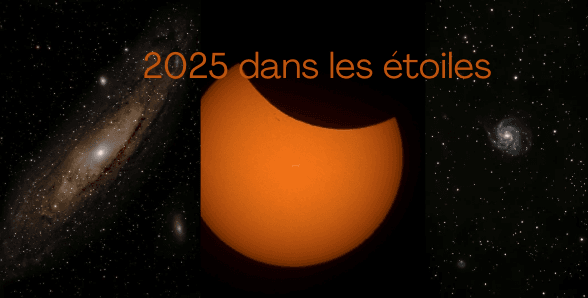
Prologue
I've always been drawn to anything space-related. I fell into it pretty young thanks to my uncle who, one evening, brought out his telescope after I'd marvelled at a photo of the August 1999 eclipse he'd taken. That night, we started with the Moon. At that age (I must have been around 9–10), I already roughly knew the Moon was a "mini planet" with "holes", but seeing the craters and lunar seas up close through the telescope was something else.
Very quickly, he gave me a small telescope, the kind you found at Nature & Découvertes. Nothing exceptional, but more than enough to observe the Moon from home.
Over time, my uncle upgraded his gear, maybe also because his nephew was getting hooked. And from there, we got to observe Saturn and its rings, Jupiter and its moons, a bit of Mars too. What until then had only been bright points in the sky suddenly became real. Less detailed than in the books, sure, but it was there, under my kid's eyes, live from a garden.
Then the years went by. His death, high school, uni, work, family… the passion stayed in a corner of my mind, but I no longer really had the time. I made do with videos and news. Until 2025 showed up.
January – March: the relapse
Nothing particular in January 2025, a classic new year. Then one day, lost on YouTube, I stumble back on an old Amixem video: the one about the Vaonis Stellina from 2018.
I watch, I go to the Vaonis website to take a look… and cold shower: €1,600 for the automatic telescope.
I was up for getting back into it, but not for dropping €1,600 on day one. Browsing their site, I see they also offered the Hestia for a lot less. I find a deal at a retailer, I order, it arrives 48 hours later… and luckily, a perfectly clear sky, so that same evening I'm squatting the shared terrace of my building with my new toy.
Pretty decent for a start! Even if two hours outside is short, Mars was a real nightmare. The Hestia sits on the smartphone: you put the device on a tripod, place the phone on top (already a pain in itself because you have to align the lens with the Hestia's aperture), launch the app that analyses the sky to guide the pointing. For the Moon it's easy, you aim by hand. For Mars and other deep-sky objects… much less so. You have to aim roughly, increase the exposure, hope enough stars are detected, and pray the app manages to locate itself and guide you, move the device in the indicated direction, start over until you find it.
The app then takes 30 one-second photos that it stacks. Impossible to go much further without motorised tracking: beyond that, the stars stretch and you get smeary dots. But I was already super happy: I was getting observation back, and above all… I was seeing deep sky for the first time. And of course: I wanted more.
You can already see it on these images: quality depends enormously on the smartphone, and star trails show up fast.
March – July
Playing in alt/az mode
In parallel, I keep looking at what setup could let me combine observing and photography, with more detail. But of course, it adds up fast:
- Optical tube: €400–500
- Alt/Az or equatorial mount: ~€500 for Alt/Az, €1,000–1,200 for a motorised EQ
- Deep-sky camera: ~€800–1,000
And that's for a fairly basic setup.
So I decide to stay reasonable (for now). And then I come across the Seestar S30: a smart telescope designed for deep-sky astrophotography, at a much more accessible price. I cave. It arrives late March, the day before a partial eclipse (as luck would have it).
First slap in the face. Not only was it my first eclipse, the result blew me away. And what followed was just as delightful:
Like a kid. The first captures were in Alt/Az, so short exposures (10–20s). Processing stayed simple, mainly built-in denoising.
EQ mode arrives
In April, ZWO enables EQ mode. Better tracking, real compensation for Earth's rotation.
In the meantime, I'd been diving into astrophotography videos: exposure time, stacking, sorting, Siril, Photoshop… and that's when I understood that astrophotography is a whole huge world. I pick up the basics, but I level up slowly.
Done with the "rush" sessions where I just wanted as many objects as possible: each target now takes several evenings, dozens (even hundreds) of frames, sorting, stacking, processing. I sometimes spend up to 20 hours cumulative per photo (between the night sessions and the processing).
July – September: planetary
The S30 excels on deep sky, but it's rubbish for planetary. I tried on Jupiter and Mars, and apart from a glowing blob it really wasn't great. I wanted to get back to "eyepiece" observing, to see some detail.
I find a used Bresser Messier 127/1900 near me, and a Skywatcher AZ-GTi for tracking (perfect for observing and lucky imaging ).
And that's childhood all over again. Incredible details on the Moon, Saturn and its ring finally visible, and I'm having a blast. While the Seestar is taking the frames of a target, I'm blowing my mind on Saturn and the Moon with the BM. In August, I also cave for a ZWO ASI 662MC planetary camera (a camera that can record at high FPS). Plenty of hassle at first (getting to grips with the software, I can't find my target on the screen, fiddly settings)… but in September, first (small) win:
Since September: not much… except M31
The end of the year was complicated: very few clear nights. Only six usable evenings in October, which I almost all dedicated to M31. If you're interested, I go into more detail here: Andromeda article.
What's next in 2026?
I want to go even further. The release of the S30 Pro and its 4K should make it possible to get even nicer deep-sky images. In the medium term (maybe 2027), I'd like to build a real astrophotography setup with a dedicated refractor and camera, but with the S30/S30 Pro, that's not an immediate priority.
For 2026, the main goal will be planetary. Jupiter is coming, and I want a really nice Saturn. An HEQ5 Pro-type mount will probably join the family eventually.
In the meantime, feel free to have a look at the astro gallery to follow what comes next!
I help teams with this kind of split — short audits or longer engagements.
Let’s talk